| Stomachion |  |
||||
 |
|||||





 |
The Four-Colour Theorem The "Four-Color Theorem" or the "Four-Color Problem" was first formulated in 1852 by the South African mathematician Francis Guthrie (1831-1899) when he attempted to color the counties of England on a map in such a way that no two adjacent regions received the same color. It was obvious that three colors were not sufficient for this task. On the other hand, Guthrie could not construct an example where five colors were needed. But is it always the case that four colors are sufficient, mathematically proving that regardless of the shapes and sizes of the regions? Although many mathematicians attempted to solve the problem, it took 124 years until 1976 when American mathematicians Kenneth Appel and Wolfgang Haken found a proof with the help of a computer, reducing the number of problematic cases from infinite to ultimately 1,476. Then, in 2004, a formal proof was constructed using a software program called "Coq," rendering the need for verifying remaining individual cases unnecessary. The Four-Color Theorem was the first major mathematical problem to be solved with the aid of computers. However, the proof was not universally accepted by all mathematicians because it cannot be directly replicated by a human, relying instead on the correctness of the compiler and hardware. The mathematical elegance of the proof was also criticized: a good proof reads like a poem - this one looks like a phone book.
|
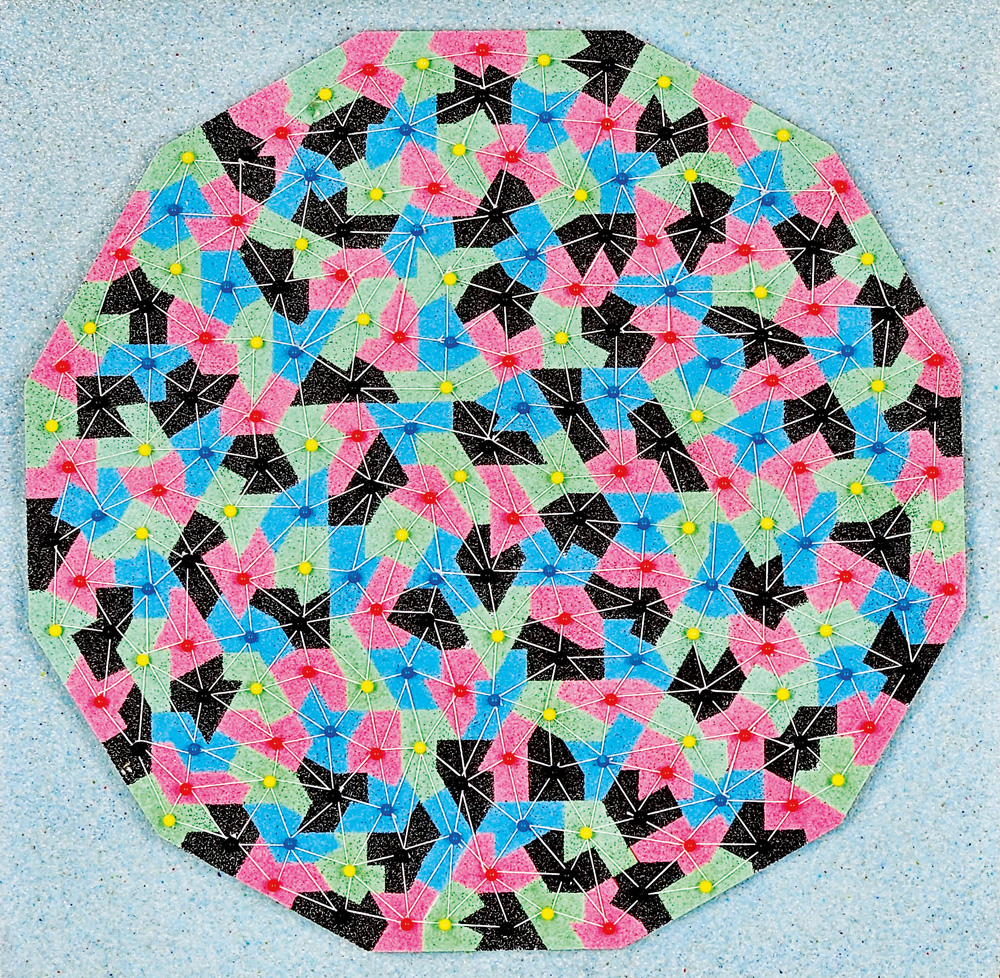
The solution of the Eternity Puzzle in four-color representation. Even the blue background is integrated into the four-color requirement (color sand, pins, and thread on lightweight board and painting cardboard, 40 x 40 cm). Click on the image to watch the explanatory video. |
|
In the above image, the Eternity Puzzle was used as an example for the area coloring. The Eternity Puzzle was developed by the Englishman Christopher Monckton in 1999. He offered a prize of 1 million pounds (approximately 3.4 million German marks at the time) for the first correct solution submitted. The puzzle consists of 209 monochrome pieces to be assembled into a regular dodecagon. Schematically, all pieces consist of halved, equally sized, equilateral triangles, with approximately 12 pieces forming one puzzle piece. All pieces are different from each other and none has rotational or reflection symmetry. In the first month, the puzzle became the best-selling game of all time in the United Kingdom. With the help of several computers, the two Cambridge mathematicians Alex Selby and Oliver Riordan found the first solution on May 15, 2000, nearly a year after the game was released. |